Why we do this at all
People already ask AI assistants about their money. They just do it however they can: they paste bank statements with full account numbers into the chat, upload screenshots from their banking app, and some tools even ask for online banking logins and passwords. The assistant then gets everything at once, with no control, and nobody knows what happens to it next.
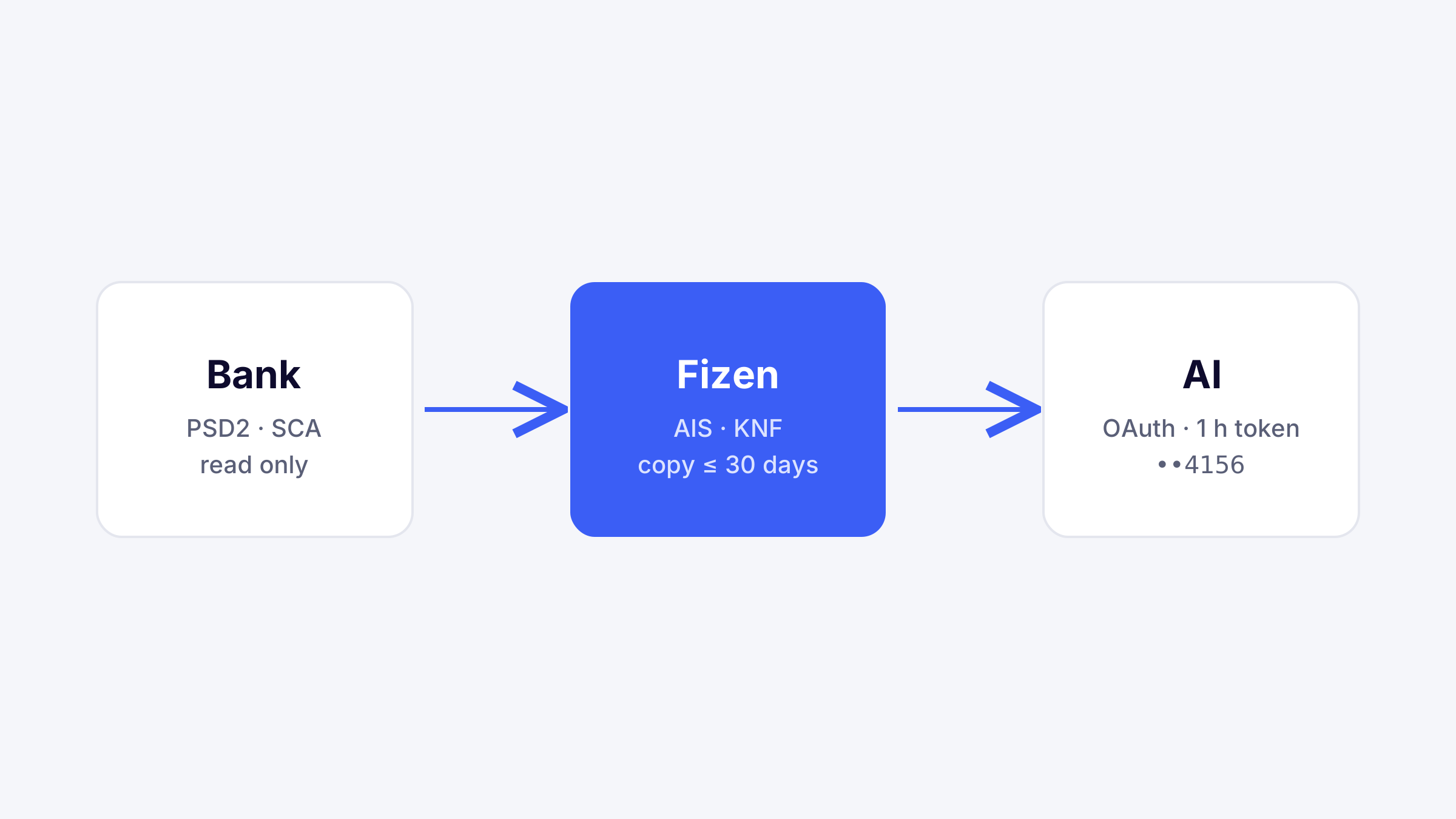
Fizen is an account information service provider (AIS) registered by the Polish Financial Supervision Authority (KNF) under number AISP13/2022. Fizen MCP is a lawful, controlled way to the same goal: the assistant sees your finances, but only the accounts you share with it, only what it asks for, without your passwords, with access you can cut off at any moment and a record of every read that you can review.
Who is who
- Your bank runs the account and shares data on the basis of your consent.
- Fizen fetches the data from the bank (the AIS service) and answers assistants' requests. It is the controller of your data.
- The assistant's provider (e.g. Anthropic, OpenAI, Google) runs the conversation with you. It is a separate controller of the data it receives.
How the data flows, step by step
1. Consent in the bank. You link the bank in your Fizen account and approve the consent in your bank, like a transfer (strong customer authentication). The consent is read only and lasts up to 180 days. We never learn your online banking login or password.
2. Fetching the data. Right after your consent Fizen fetches the balance and the whole transaction history the bank makes available (the bank decides how far back: from about three months to several years). Without you present the bank then allows only a few reads a day, so we keep a copy of the data on Google Cloud servers in Warsaw. Later reads add new transactions, so the history grows and you can ask about transfers from months ago. How much of it the assistant sees depends on your plan (90 days on the free one). We delete the copy if it has not been refreshed for 30 days (you stopped using the service or the consent expired), and at once when you remove the bank from your Fizen account. To be fair: after such a break the bank usually gives only the last 90 days or so without a new approval, so the older part has to be fetched again by linking the bank once more.
3. Connecting the assistant. In the assistant you add Fizen as a connector and sign in to your Fizen account. On the consent screen you see the app's name and the permissions, and you choose which accounts this app will see. Clicking “Allow” is your consent to sharing data with this app: separate from the consent in your bank and separate for each assistant. The assistant receives an access token (the OAuth 2.1 standard): it works only for that app and those accounts, is valid for an hour and keeps being renewed as long as the assistant uses it at least once every 30 days. We keep it only as a hash. Disconnecting the app in your Fizen account works immediately.
4. A question. When you ask the assistant, say, "how much did I spend on food in September", its servers call a tool at mcp.fizen.com over an encrypted connection. We answer only that one call, only from the shared accounts. The assistant asks us, not the other way round: we send nothing on our own.
What exactly the assistant receives
- about an account: the bank, the account name, the number masked to its last 4 digits (e.g. ••4156), the currency, the holder's name, the balance with the time it was fetched;
- about transactions: date, amount, counterparty name, the counterparty's account number masked to its last 4 digits, title and category (e.g. groceries, subscriptions).
What the assistant never gets
- full account numbers, neither yours nor your counterparties';
- online banking logins, passwords or codes (we do not know them);
- our tokens and keys;
- other users' data, or accounts you did not share with it.
Do we anonymise the data? No. And we say so plainly
We mask account numbers. But counterparty names, transfer titles and your name as the account holder go to the assistant as the bank sent them. Without them the assistant cannot answer "how much do I pay for internet" or "who sent me 200 zł". Legally this is data minimisation and partial pseudonymisation, not anonymisation.
We only remove characters invisible to a human (which can smuggle hidden instructions to a model) from titles and names, and limit their length. If you do not want an assistant to see an account, simply do not share it; you can change that at any time under AI apps.
What Fizen sees
We do not see your conversation with the assistant. We see only the calls to our tools: which tool, when, through which app, with which parameters (e.g. the search phrase "pharmacy") and how many items we returned. This is how we keep it:
- request parameters are deleted after 90 days;
- the fact of the call stays in the history of events for 5 years, as the AIS Terms say, which is how we show that we act within your consent;
- you see the last 500 calls yourself in your Fizen account, under Activity;
- the number of requests per day, without their content, is kept for 400 days for plan billing.
What happens on the assistant's side
What we return becomes part of your conversation with the assistant. The provider keeps it under its own terms and your settings, including any use of conversations to train models. It may process it outside the European Economic Area, usually in the United States. We have no influence on that and we will not pretend otherwise. Before you link a bank, check your assistant's privacy settings and turn off what you do not want.
Transfer titles are someone else's text
A transfer title is written by the sender. Someone can send you 1 grosz with a title posing as an instruction to the assistant or with a link to a fake sign-in page. So we mark such texts as data, not instructions, strip them of invisible characters and instruct the assistant never to follow instructions from titles, never to open links from them, and to warn you about such content.
What we do not promise
- The data may be a few hours old; the assistant receives the time of the fetch and should tell you.
- The assistant can get a calculation or a conclusion wrong. Its answers are not financial advice.
- The assistant's provider, not us, is responsible for what it does with the data afterwards.
How to cut off access
- disconnect the app in your Fizen account (AI apps): it works immediately, but does not delete what the assistant has already received. You delete that with its provider, by deleting conversations as it instructs;
- remove the bank from your Fizen account: we delete its accounts and data copies;
- withdraw the consent in your bank;
- delete your Fizen account in Settings.
The full rules are in the Fizen MCP Terms, the AIS Terms (both in Polish) and the Privacy Policy (section 10). If anything here is unclear or does not match what you see, write to [email protected].