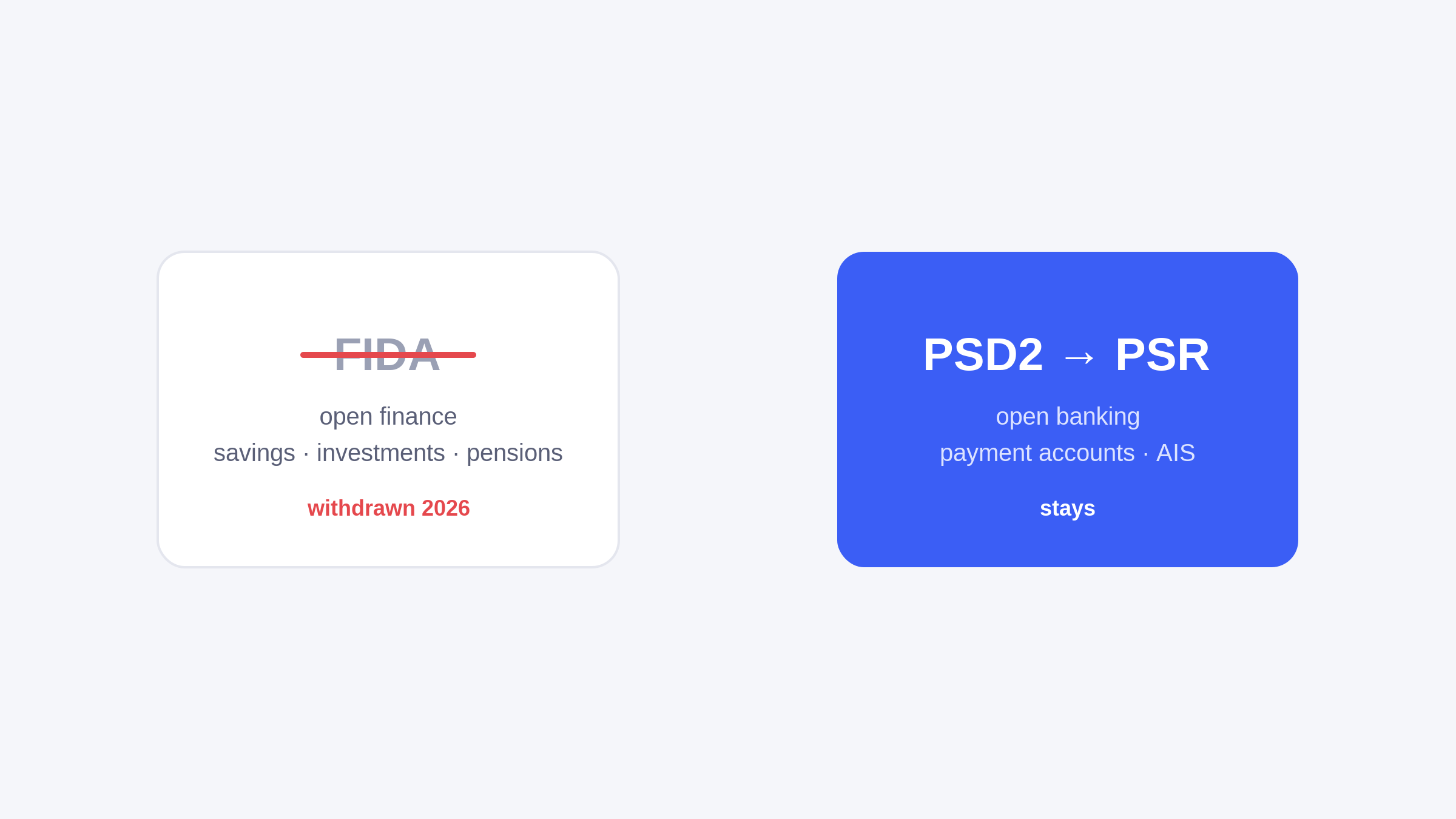
On 4 November 2026 the European Commission put the FIDA regulation (Financial Data Access) on the list of proposals to withdraw in its 2027 work programme. After more than three years of negotiations, EU open finance as a legal obligation will not happen. Open banking on payment accounts, which is what Fizen runs on, stays as it is, and its future is now set by PSR.
What FIDA was meant to be
FIDA was to carry the logic of PSD2 from payment accounts to the whole financial sector. The Commission published the proposal on 28 June 2023, in one package with PSD3 and PSR. Its main points:
- Wider data: savings, loans, investments, insurance and pensions, not only payment accounts.
- More institutions: banks, asset managers, insurers and pension funds as data holders.
- A new FISP licence (Financial Information Service Provider) for those using the data.
- Mandatory data sharing schemes, with technical rules, liability and compensation for data holders.
- Permission dashboards, where customers see and revoke the permissions they gave.
A customer, including a small business, could pass this data to a provider of their choice in a machine-readable form. Exactly as they pass their account history today through the AIS service Fizen provides.
What the Commission announced and why
FIDA is item 5 of the 18 proposals in Annex III ("Withdrawals") of the Commission's 2027 work programme. The reasoning is short: the proposal has waited with the co-legislators for over three years, no trilogue has taken place since June 2025, and it has no chance of Council support in reasonable time. Behind that technical argument are three forces:
- The simplification agenda. After the Draghi report the Commission is cutting regulatory burden. A new data sharing obligation for the whole financial sector went against that.
- Resistance from financial institutions. Banks, insurers and asset managers would have had to share customer data with competitors, and feared most that large non-EU tech platforms would benefit.
- Member states. As early as January 2025 France asked for a thorough economic impact assessment of FIDA and for the proposal to be revised or withdrawn.
Timeline: is this the end?
Politically yes, formally not yet. The Commission intends to withdraw the Annex III proposals within six months, around May 2027. Before that Parliament and Council may give their views, and the withdrawal must be published in the Official Journal of the EU.
| Date | Event |
|---|---|
| 28 June 2023 | The Commission publishes FIDA together with PSD3 and PSR |
| February 2025 | A leak about a planned withdrawal; the Commission keeps the proposal in the end |
| June 2025 | The last trilogue on FIDA |
| 3 November 2026 | MLex reveals a draft programme with FIDA on the withdrawal list |
| 4 November 2026 | The Commission adopts its 2027 work programme, FIDA in Annex III |
| around May 2027 | Expected formal withdrawal and publication in the Official Journal |
A reversal is possible but unlikely. In February 2025 a similar leak was not confirmed, but then FIDA was not in an officially adopted document. Now it is, and the Commission has announced nothing in its place.
What stays: open banking carries on
Withdrawing FIDA does not touch AIS and PIS on payment accounts. They still rest on PSD2, soon to be replaced by the directly applicable PSR regulation. Our colleagues at Binar explain what PSR changes in PSD3 and PSR: the end of the PSD2 era.
- PSR: a provisional trilogue agreement was reached on 27 November 2025. The Council's position was published on 5 November 2026, and Parliament's final vote is provisionally scheduled for 14 December 2026.
- PSD3: the directive on licensing and supervising payment institutions travels in the same package as PSR.
- Data Act: applies since 12 September 2025, but covers data from connected devices and services, not financial account data.
So only the open finance layer goes. Access to data on savings, investments, insurance or pensions will depend on commercial agreements, not on a legal obligation. There will be no FISP licence.
What it means for the market
Open finance in the EU will not disappear, but it will be built bottom-up: through market schemes such as the European Payments Council's SPAA, and commercial APIs, not regulation.
| Who | What changes |
|---|---|
| Fintechs and AIS/PIS providers | No statutory right to data beyond payment accounts. Products built on investment or pension data need bilateral agreements with each institution. |
| Banks, insurers, asset managers | No obligation to build new interfaces or join FIDA schemes. Customer data stays a competitive advantage that can be monetised through paid APIs. |
| Companies building financial products | Open banking integrations based on PSD2 and PSR remain a stable foundation. Any wider data integration is a separate project with a separate partner. |
| Customers, including SMEs | No uniform right to move financial data. Aggregating savings or pensions in one app will depend on the institutions' goodwill. |
Those who already have working bank integrations gain the most. Without regulation to level the field, access to data beyond payment accounts becomes a matter of negotiation, not of a licence.
Fizen's perspective
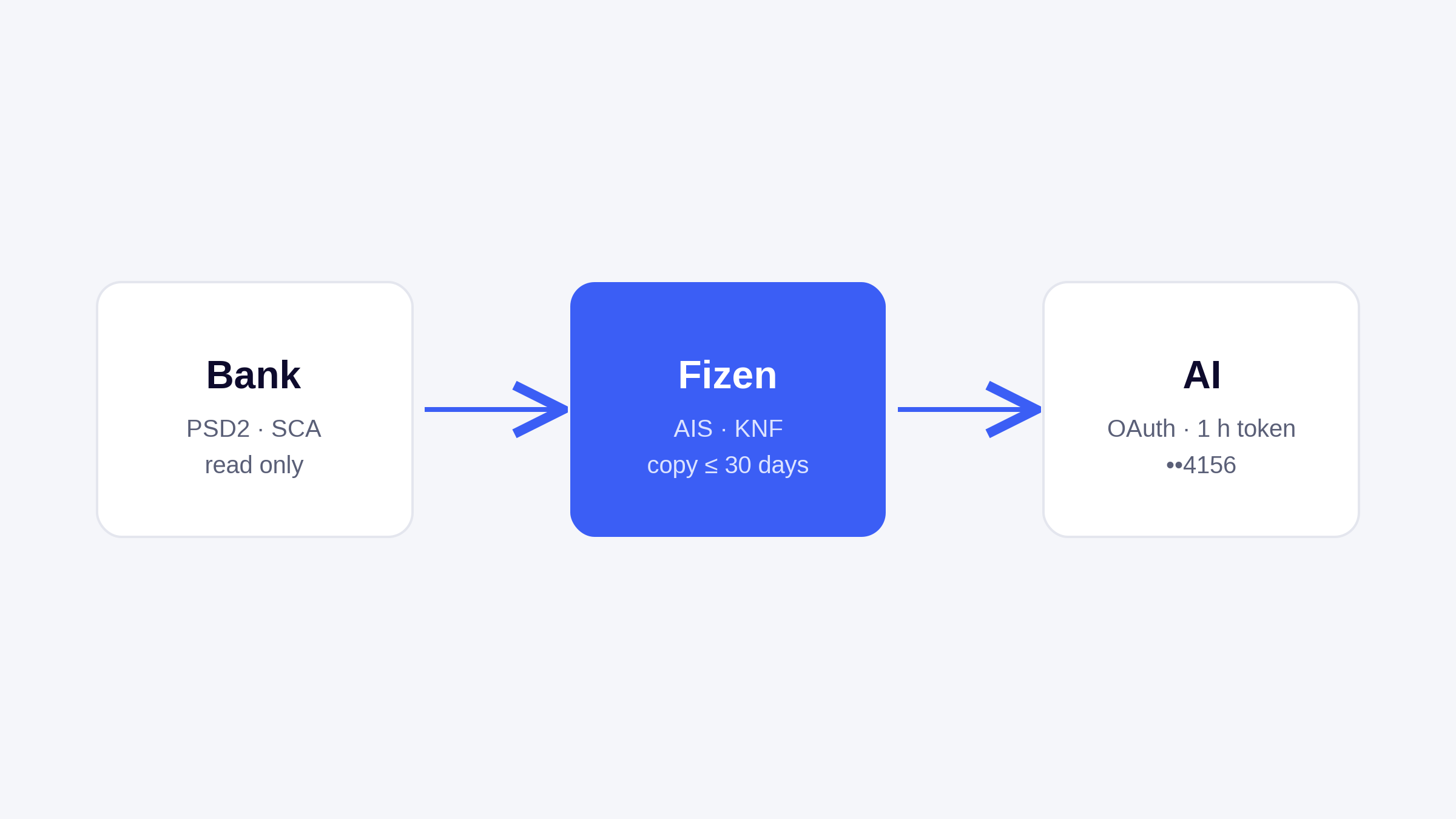
Fizen is an account information service provider (AIS), registered with the Polish Financial Supervision Authority (KNF) under AISP13/2022. We give companies and developers one API to banks in Poland and Central Europe, and people and businesses an account where they see their accounts from every bank, in AI assistants too. From where we stand, the withdrawal of FIDA is an important signal, not an earthquake: everything we do rests on PSD2, and once it applies, on PSR. That foundation is not going anywhere.
Two things FIDA wanted to impose on everyone we already offer, with no obligation:
- A permission dashboard. In the Fizen account users see every bank consent and every app with access to their data, and revoke it in one click.
- Data that means something. A raw account history is only the start. We categorise transactions with open rules, published under Apache 2.0 as fizen-categories.
Our recommendations for companies planning products built on financial data:
- Build on PSD2 and PSR. It is the only layer of access to financial data with a legal guarantee across the EU, and it is not going away. The fastest way is a licensed AIS provider rather than your own licence and an integration with every bank.
- Do not wait for regulation for the rest of the data. If your product needs investment or insurance data, plan partnerships with specific institutions.
- Design for many sources. Regulated and commercial integrations will coexist, so your data layer should support both.
- Follow PSR implementation. New rules on interfaces, consents and liability will change the daily work of AIS and PIS providers sooner than any debate about open finance.
Fizen and Binar
Fizen is part of the Binar Group. Fizen runs the regulated service and the products, and the engineering team at Binar has spent over 11 years building regulated fintech products, including Fizen's infrastructure. How it was built is in the Fizen case study on binar.com. If you need not just an API but a whole product built on open banking, including custom integrations, see Binar's open banking services. For more on what was meant to follow PSD2, read PSD3, PSR and open finance.
Planning a product built on account data? Start with Fizen API for developers and the pricing, or write to [email protected].
FAQ
Has FIDA been formally withdrawn?
Not yet. The Commission announced the withdrawal in its work programme of 4 November 2026, and the formal step is expected around May 2027.
Does the withdrawal affect open banking, PSD2 and Fizen?
No. AIS and PIS on payment accounts work under PSD2, and in future PSR. Fizen works as before.
What was the FISP licence?
A new type of authorisation for financial information service providers, foreseen in FIDA. With the regulation withdrawn, it will not exist.
Will open finance still happen in the EU?
Yes, but through the market: industry schemes and commercial APIs, with no legal obligation for financial institutions.
When will PSR apply?
Parliament's final vote is provisionally scheduled for 14 December 2026. Once published, the regulation will have a transition period.